What Is Bac Water? A Simple Guide to Bacteriostatic Water

If you have come across the term bac water while reading about injectable medicines, peptides or other products that need to be reconstituted before use, you may be wondering exactly what it is and why it is different from ordinary sterile water.
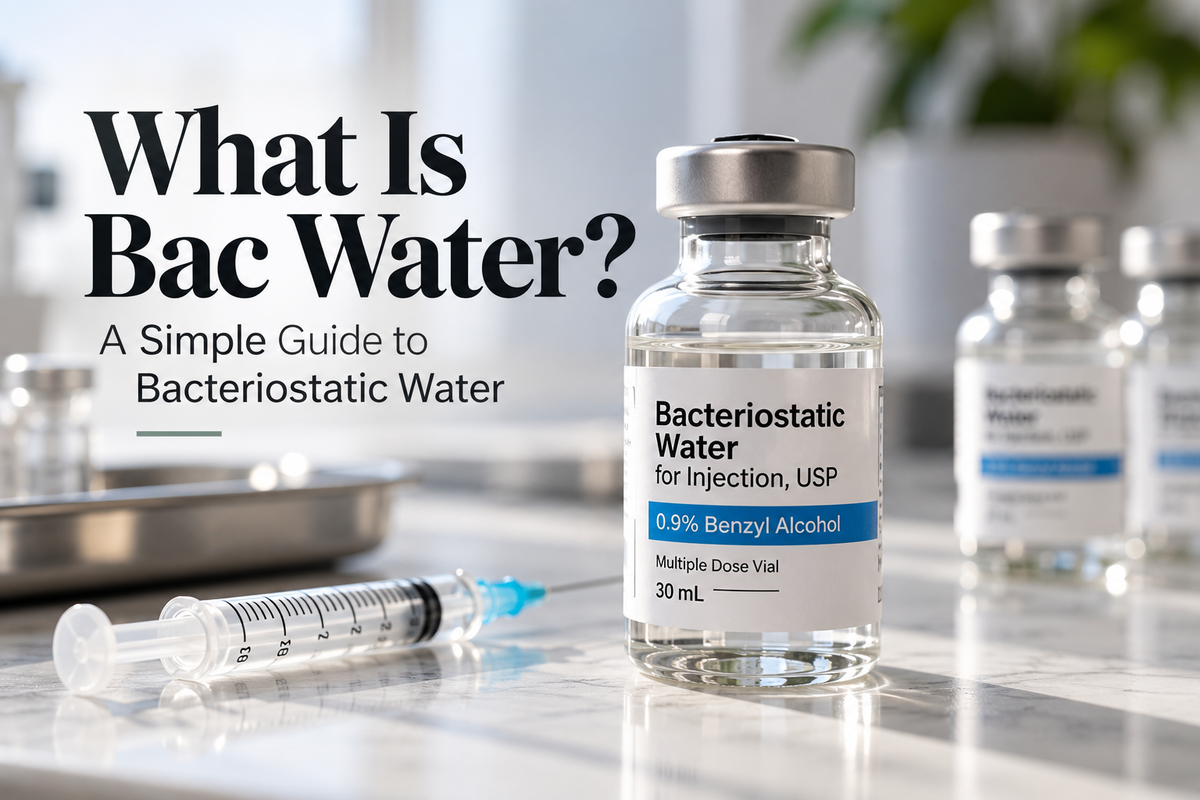
Bac water is short for bacteriostatic water, a sterile preparation of water designed to be used as a diluent for certain injectable medicines. It usually contains a small amount of benzyl alcohol, which acts as a preservative and helps inhibit the growth of bacteria after the vial has been opened.
If you are researching bac water, the most important thing to understand is that it is not simply bottled water and it is not interchangeable with every other injectable diluent.
Its use depends on the medication being prepared and the manufacturer's instructions.
What is bac water?
Bacteriostatic Water for Injection is sterile, nonpyrogenic water that contains a bacteriostatic preservative.
A commonly used formulation contains 0.9% benzyl alcohol, although formulations can vary by product. The preservative is what separates bacteriostatic water from ordinary Sterile Water for Injection. DailyMed
It is normally supplied in a multidose vial.
The purpose of the water is not to act as a medicine on its own. Instead, it is used to dissolve or dilute certain medicines that are supplied in concentrated or powdered form before administration.
The official product labelling states that bacteriostatic water is intended for use only after a compatible drug has been added according to that drug manufacturer's instructions. DailyMed
Why does bacteriostatic water contain benzyl alcohol?
The main difference between bacteriostatic water and plain sterile water is the addition of a preservative.
Benzyl alcohol helps limit bacterial growth after the vial has been punctured.
That is why bacteriostatic water is commonly supplied in multidose containers, where more than one withdrawal may be permitted when the product is handled correctly and within the manufacturer's requirements. DailyMed
The word bacteriostatic itself essentially refers to slowing or preventing bacterial growth rather than directly sterilising something.
It is important to understand that the preservative does not make poor handling safe.
Sterile technique and the instructions supplied with both the diluent and the medicine still matter.
What is bac water used for?
Bacteriostatic water is primarily used to reconstitute or dilute certain injectable medicines.
Some medicines are supplied as powders or highly concentrated preparations because they may not remain stable for long periods once mixed into a liquid.
Before administration, an appropriate diluent is added to prepare the medicine at the required concentration.
Depending on the medicine, that diluent may be:
- Bacteriostatic Water for Injection
- Sterile Water for Injection
- Sodium chloride solution
- Another manufacturer-approved diluent
The correct choice depends on the medicine itself.
Bacteriostatic water should therefore not be assumed to be suitable for every injectable product.
The medication's official instructions should specify which diluents are compatible. DailyMed
Bac water vs sterile water: what is the difference?
The two products sound very similar, but there is an important difference.
Bacteriostatic water
Bacteriostatic water contains sterile water plus a preservative, commonly benzyl alcohol.
It is often packaged as a multidose product because the preservative helps inhibit bacterial growth following repeated withdrawals.
Sterile water
Sterile Water for Injection does not necessarily contain the same preservative.
Products without a bacteriostatic preservative are generally treated differently after opening and may be required for medicines or patients where benzyl alcohol is inappropriate.
This means bac water and sterile water are not automatically interchangeable.
Always follow the instructions for the medicine being prepared rather than substituting one diluent for another.
Is bac water the same as saline?
No.
Bacteriostatic water and saline are different preparations.
Bacteriostatic water is essentially sterile water containing a bacteriostatic preservative.
Saline contains sodium chloride in addition to water.
There is also a product called Bacteriostatic 0.9% Sodium Chloride Injection, which contains both sodium chloride and benzyl alcohol. That is a separate preparation from Bacteriostatic Water for Injection. DailyMed
The distinction matters because different medicines require different diluents.
Can bacteriostatic water be injected by itself?
Bacteriostatic water is intended as a drug diluent, not as a general injection or fluid-replacement product.
Official labelling states that it is designed for use after the addition of a medicine requiring dilution or dissolution. It must also be made appropriately isotonic before certain uses. DailyMed
In practical terms, that means bacteriostatic water should not be treated as something to inject on its own simply because it is sterile.
Its purpose is to help prepare compatible medicines.
Is bac water safe?
When used for an appropriate medicine and according to professional and manufacturer instructions, bacteriostatic water is an established pharmaceutical diluent.
There are, however, important warnings.
One of the biggest concerns relates to benzyl alcohol.
Bacteriostatic Water for Injection containing benzyl alcohol is labelled not for use in neonates because benzyl alcohol exposure has been associated with severe and potentially fatal reactions in newborn infants. DailyMed
Official labelling also states that benzyl-alcohol-containing preparations should not be used for fluid replacement or for epidural or spinal anaesthesia procedures. DailyMed
This is one reason it is important to distinguish bacteriostatic water from other sterile diluents.
Does bac water contain alcohol?
Yes, but not in the way people normally mean when talking about alcohol.
The preservative commonly used in bacteriostatic water is benzyl alcohol, not the ethanol found in alcoholic drinks.
A typical formulation contains approximately 0.9% benzyl alcohol, equivalent to 9 mg/mL. DailyMed
Its role is pharmaceutical preservation rather than intoxication or flavour.
Why is bac water supplied in multidose vials?
The benzyl alcohol preservative allows bacteriostatic water to be packaged for multiple withdrawals under appropriate conditions.
This can be useful when a compatible medicine requires repeated preparation rather than using the entire vial at once.
However, "multidose" does not mean a vial can be kept indefinitely.
Users should follow the storage, handling and discard instructions supplied with the specific product and any guidance associated with the medicine being reconstituted.
If the solution is cloudy, contaminated, damaged or otherwise does not meet the manufacturer's instructions, it should not be used.
How should bacteriostatic water be stored?
Storage instructions vary by manufacturer.
For example, some US-labelled Bacteriostatic Water for Injection products specify controlled room-temperature storage around 20°C to 25°C. DailyMed
The label on the actual product should always take priority.
It is also important to protect the vial from contamination and follow the manufacturer's requirements after the stopper has first been punctured.
Can any medication be mixed with bac water?
No.
This is probably one of the most important points to understand.
The fact that a medicine needs to be mixed with a liquid does not automatically mean bacteriostatic water is the correct liquid.
Some injectable medicines specifically require sterile water.
Others require saline.
Some may have an entirely different approved diluent.
The manufacturer's prescribing information should state what can be used.
Using the wrong diluent can potentially affect concentration, stability, compatibility or safety.
Why do people call it "bac water"?
"Bac water" is simply a shortened, informal term for bacteriostatic water.
You may also see phrases such as:
- Bacteriostatic water
- Bacteriostatic Water for Injection
- BWFI
- Bac water
When discussing medical use, the complete product name is more useful because it makes clear that the preparation is specifically intended as an injectable-drug diluent.
Bac water FAQs
What does bac water stand for?
Bac water is shorthand for bacteriostatic water.
Is bacteriostatic water sterile?
Bacteriostatic Water for Injection is manufactured as a sterile, nonpyrogenic preparation. DailyMed
What preservative is in bac water?
A common formulation contains 0.9% benzyl alcohol as the bacteriostatic preservative. DailyMed
Is bac water the same as sterile water?
No. Bacteriostatic water contains a preservative, whereas Sterile Water for Injection may not.
Is bac water the same as saline?
No. Saline contains sodium chloride, while standard bacteriostatic water does not.
Can bac water be used with every injectable medicine?
No. Use only the diluent specified by the medicine manufacturer or healthcare professional.
Can newborn babies receive bacteriostatic water?
Benzyl-alcohol-containing bacteriostatic water carries a specific warning stating that it must not be used in neonates. DailyMed
The bottom line
So, what is bac water?
It is a sterile pharmaceutical preparation of water containing a bacteriostatic preservative, most commonly benzyl alcohol, and is primarily used to dilute or dissolve certain medicines before injection.
Its key advantage over plain sterile water is the presence of the preservative, which allows appropriately labelled products to be supplied in multidose containers.
But that does not make bacteriostatic water suitable for every medication or every patient.
The correct diluent always depends on the medicine being prepared, so the product label and healthcare professional's instructions should take priority.
This article is for general educational purposes and is not a guide to preparing or injecting medication.