DTF Transfers Miami: A Guide to Custom Transfers for T-Shirts and Apparel

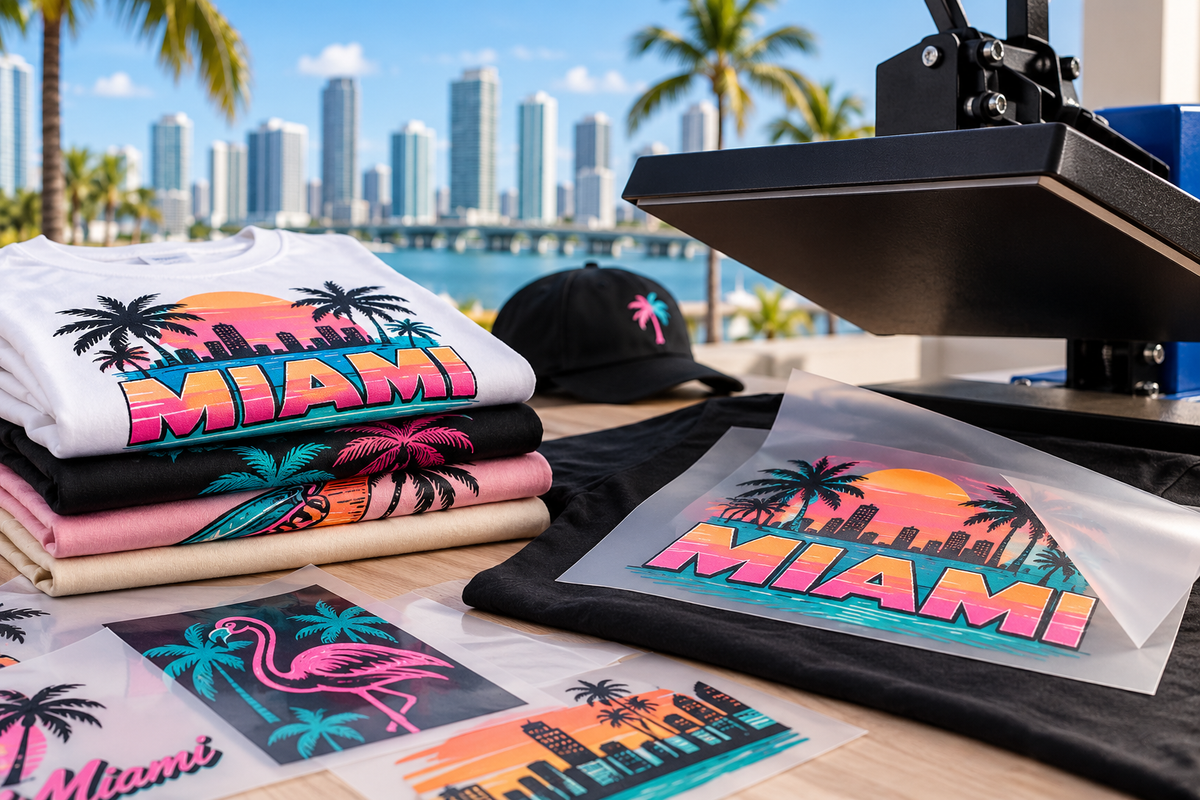
Miami has always had a strong visual identity.
From streetwear and nightlife to gyms, restaurants, events and independent clothing brands, custom apparel fits naturally into a city where standing out matters.
That is one reason DTF transfers in Miami have become such a useful option for businesses, creators and anyone producing custom clothing.
DTF printing allows detailed artwork to be transferred onto T-shirts, hoodies, sweatshirts and other garments without requiring the larger production runs often associated with traditional screen printing.
Whether you are launching a small clothing collection or need shirts for an upcoming event, here is what to know before ordering DTF transfers.
What are DTF transfers?
DTF stands for direct-to-film.
Rather than printing directly onto a garment, the design is first printed onto a specialised transfer film. It is then applied to the fabric using heat and pressure.
One of the biggest advantages is the amount of detail DTF can reproduce.
Multicolour graphics, gradients, fine lettering and complicated illustrations can all be incorporated into a single transfer.
That makes it particularly useful for designs that would be difficult to recreate using traditional vinyl.
DTF can also work across several common garment materials, including cotton, polyester and many blended fabrics, although you should always check the specific requirements of the transfer you are using.
Why DTF transfers work well in Miami
Miami has a particularly broad market for customised clothing.
Independent fashion brands are an obvious example, but DTF printing can also work well for hospitality businesses, gyms, event organisers, musicians and local companies.
Restaurants may want branded shirts that customers would actually buy rather than standard staff uniforms.
Fitness studios can create member merchandise.
Event organisers can produce limited-edition clothing without committing to hundreds of units.
For smaller businesses, that flexibility is valuable.
Instead of ordering a huge quantity of finished garments before knowing whether a design will sell, you can produce smaller batches and increase production if demand is strong.
Where to order DTF transfers
There are plenty of DTF suppliers available, so it is worth comparing more than price alone.
If you are looking at options for custom printing, you can visit website to explore DTF transfers and related printing options.
When comparing suppliers, pay particular attention to print sharpness, colour quality, adhesion and how the finished transfer feels once pressed onto a garment.
A transfer that costs slightly less is not necessarily good value if it begins cracking or lifting after a few washes.
What makes a good DTF transfer?
Good printing should look sharp even when the artwork contains relatively small details.
This becomes particularly noticeable with typography and logos. Small text that looks slightly soft in the original print can become even less defined once transferred onto fabric.
Colour is another major factor.
Miami-inspired designs often involve bold shades, including pink, turquoise, orange, red and electric blue. Those colours need to remain strong after pressing rather than appearing dull against the garment.
The white underbase is also important, especially when printing onto darker clothing. It helps brighter colours maintain their opacity rather than disappearing into black, navy or charcoal fabric.
Finally, the transfer should feel reasonably flexible. Large prints that become extremely rigid can make otherwise good clothing uncomfortable to wear.
DTF transfers vs screen printing
Both printing methods can produce excellent results, but they suit different projects.
Screen printing tends to become particularly attractive when producing large quantities of the same relatively simple design.
DTF offers more flexibility for smaller batches and artwork containing multiple colours or fine details.
For example, a new Miami streetwear brand might want to produce only 20 or 30 shirts to test a design.
Setting up a traditional screen-printing run may not make sense at that scale, particularly if the artwork contains several colours.
DTF allows the brand to experiment without committing to a large inventory immediately.
If the shirts sell quickly, more transfers can be ordered.
If they do not, the business has avoided being left with hundreds of unsold garments.
What garments can you use?
T-shirts are the obvious starting point, but DTF is not limited to basic tees.
Depending on the transfer specifications, it can be suitable for hoodies, crewneck sweatshirts, tote bags, workwear and some performance garments.
The quality of the blank matters almost as much as the transfer itself.
A detailed print placed onto an uncomfortable, badly fitting shirt will still feel like a poor-quality product.
Streetwear brands may prefer heavyweight oversized blanks, while an event organiser might want a lighter conventional T-shirt.
A gym or fitness studio may need polyester or blended performance clothing instead.
Choose the garment around the intended customer rather than treating it as an afterthought.
Getting the transfer size right
Sizing can completely change how a design looks.
A graphic that feels perfectly proportioned on an oversized XL shirt may overwhelm a smaller fitted tee.
Small left-chest designs work particularly well for logos and subtle branding.
Standard central chest prints suit most merchandise.
Larger front and back graphics tend to work better for fashion and streetwear.
One easy trick is to print the artwork onto ordinary paper at the intended dimensions and place it on the garment.
It gives you a surprisingly accurate idea of whether the transfer will feel too large or too small before spending money on the actual print.
Gang sheets can make ordering easier
If you need several graphics, a gang sheet may be worth considering.
A gang sheet allows multiple designs or sizes to be arranged on one larger printed sheet before being cut apart.
A clothing brand could place a small chest logo, large back artwork and several sleeve graphics onto the same sheet.
It can also be useful when testing several designs at once.
Rather than ordering each graphic individually, everything can be organised together and separated before pressing.
Do you need a heat press?
For consistent results, a heat press is normally the best option.
Successful DTF application depends on the correct combination of temperature, pressure and pressing time.
Too little pressure may stop the adhesive from bonding properly.
Too much heat can damage some fabrics.
Peeling the film too early can also affect the design.
Follow the instructions supplied with the transfer instead of assuming every DTF product uses identical settings.
You may also see transfers described as hot peel or cold peel.
Hot-peel film is removed relatively quickly after pressing, while cold-peel film needs time to cool first.
Using the wrong method can ruin a perfectly good transfer.
DTF transfers for Miami clothing brands
Miami is particularly suited to small apparel labels.
There is plenty of visual inspiration, but you do not have to create stereotypical tourist merchandise.
Art Deco architecture can inspire pastel colour palettes and geometric typography.
The city’s automotive culture works naturally with vintage racing graphics.
Nightlife can translate into darker garments with neon-style artwork.
Tropical colours can be used without necessarily filling every shirt with palm trees.
More understated designs can work equally well.
A cream heavyweight shirt with simple Miami typography may feel considerably more premium than a complicated souvenir-style graphic.
The flexibility of DTF makes it easy to test several directions before deciding what becomes part of a permanent collection.
DTF for restaurants, gyms and events
Fashion is only one part of the market.
Miami’s hospitality sector creates a particularly good opportunity for interesting branded apparel.
A restaurant can create graphic T-shirts inspired by its food or identity rather than relying on plain uniforms.
A cocktail bar could produce retro-style shirts that double as merchandise.
Gyms and fitness studios can use DTF for member clothing, competitions and limited-edition drops.
Events are another strong use case.
Conferences, festivals, private parties and brand activations may only need apparel for a particular date.
Smaller DTF runs make it possible to produce event-specific designs without being left with boxes of unused stock afterwards.
How to make DTF clothing last longer
The life of a printed garment depends on both the transfer and how it is treated afterwards.
Washing clothing inside out is generally a good habit because it reduces direct friction against the printed surface.
Very high temperatures and harsh bleaching products can also shorten the life of decorated apparel.
Extreme dryer heat is another thing worth avoiding.
Most importantly, follow the care instructions provided by the supplier because different transfers may have slightly different requirements.
Good application combined with sensible washing can make a major difference to how the print looks months later.
Common mistakes to avoid
One of the most common problems starts before anything reaches the heat press: poor artwork.
A low-resolution image will not suddenly become sharper because it is printed professionally.
Whenever possible, supply high-resolution artwork and follow the file requirements given by the printer.
Another mistake is ordering a transfer without checking its actual dimensions.
Something that looks perfect on a laptop screen can feel enormous once placed across a shirt.
Pressing errors are equally common.
Temperature alone is not enough. Pressure, timing and the correct peel method all matter.
And finally, do not invest heavily in a great transfer while buying the cheapest blank garment available.
Customers experience the finished product as a whole.
Are DTF transfers right for your project?
DTF is particularly useful if you want flexibility.
It works well for small clothing brands, restaurants, gyms, musicians, creators, events, clubs and businesses that do not necessarily need enormous production runs.
It is also a strong option when the design contains several colours or detailed artwork that would be awkward to reproduce using vinyl.
For very large quantities of simple designs, screen printing may still make more financial sense.
But for smaller or more experimental projects, DTF is difficult to ignore.
The bottom line
If you are searching for DTF transfers in Miami, start by thinking about the finished garment rather than simply the transfer itself.
Choose good artwork, a quality blank and the right transfer dimensions.
Then make sure the transfer is applied according to the recommended temperature, pressure and timing.
DTF is particularly useful in Miami because it suits the city's mix of fashion, events, hospitality, fitness and independent businesses.
It allows smaller quantities to be produced without giving up detailed graphics or strong colour, making it easier to test ideas before committing to larger orders.
For businesses and creators that want custom apparel without the complications of a huge production run, that flexibility is probably its biggest advantage.